A Complete Guide to Fast and Hassle-Free ISO Certification Process
Introduction
In the modern business world of 2026, ISO certification has become an essential standard for organizations aiming to strengthen their credibility, improve operational efficiency, and compete in both domestic and international markets. Companies today are expected to demonstrate consistent quality, structured processes, and compliance with globally accepted standards, especially when dealing with government contracts, corporate clients, or export opportunities.
ISO certification is no longer restricted to large corporations. Small businesses, startups, and MSMEs are increasingly adopting ISO standards to build trust, improve internal systems, and enhance their brand value in a highly competitive marketplace. Despite its growing importance, many organizations still find the ISO certification process complex due to documentation requirements, audit procedures, and compliance guidelines. This guide, prepared by Bizreg Software Solutions, a professional service provider, simplifies the entire ISO certification journey. It provides clear insights into the step-by-step process, key benefits, required standards, and common challenges faced by businesses. The aim is to help organizations achieve ISO certification in a structured, efficient, and hassle-free manner.
What Is ISO Certification?
ISO stands for the International Organization for Standardization, which develops global standards for quality, safety, efficiency, and management systems.
ISO certification is a formal recognition issued by an accredited certification body that confirms your business follows internationally accepted standards.
In simple terms, ISO certification proves that your company:
- Works with structured processes
- Maintains consistent quality
- Follows international best practices
- Focuses on continuous improvement
It is not just a certificate it is a business improvement system that enhances how your organization operates.
Why ISO Certification Is Important in 2026
In 2026, business competition has increased significantly across all industries. Customers, clients, and government organizations now prefer working only with certified companies.
Here’s why ISO certification is important:
1. Builds Strong Business Trust
ISO certification improves your brand reputation and builds confidence among clients and stakeholders.
2. Helps Win Tenders and Contracts
Many government and private sector tenders require ISO certification as a mandatory eligibility criterion.
3. Supports Global Expansion
ISO-certified businesses are accepted in more than 170 countries, making international trade easier.
4. Improves Operational Efficiency
ISO helps identify weak areas in your processes and improves productivity and performance.
5. Reduces Business Risks
Standardized processes help reduce errors, delays, and operational failures.
Popular ISO Standards for Businesses
There are many ISO standards available, but the most commonly used ones include:
ISO 9001: Quality Management System
Suitable for all industries. Focuses on customer satisfaction and quality improvement.
ISO 27001: Information Security Management
Used by IT companies, software firms, and data-driven organizations.
ISO 22000: Food Safety Management
Important for food manufacturers, processors, and exporters.
ISO 14001: Environmental Management
Focuses on reducing environmental impact and improving sustainability.
ISO 45001: Occupational Health & Safety
Ensures workplace safety and reduces accidents.
ISO 13485: Medical Device Quality
Used in healthcare and medical equipment manufacturing industries.
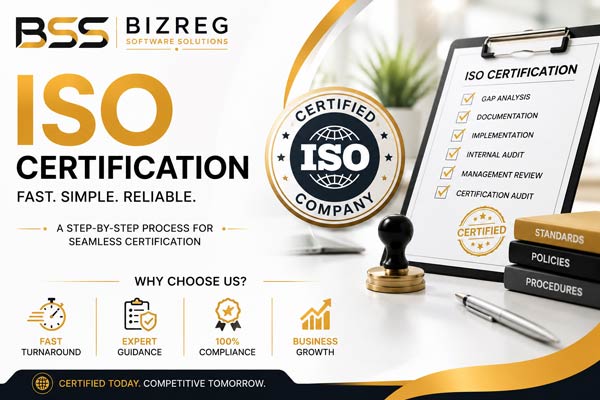
Step-by-Step ISO Certification Process
Step 1: Selecting the Right ISO Standard
The first step is identifying the correct ISO standard based on your industry and business goals. Choosing the wrong standard can delay certification.
Step 2: Gap Analysis
A gap analysis is conducted to compare your existing processes with ISO requirements. It helps identify what changes are needed.
Step 3: Documentation Preparation
This is one of the most important steps. It includes creating:
- Policies
- Procedures
- Work instructions
- Quality manuals
Proper documentation ensures compliance with ISO standards.
Step 4: Implementation of Processes
After documentation, the next step is implementing those processes in daily business operations. Employees must follow the updated systems.
Step 5: Employee Training
Training ensures that all employees understand ISO requirements and follow standardized procedures correctly.
Step 6: Internal Audit
An internal audit is conducted to identify gaps before the official certification audit. This helps correct issues in advance.
Step 7: Management Review
Top management evaluates system performance, risks, and improvements before final audit approval.
Step 8: Final Certification Audit
The certification body performs a two-stage audit:
- Stage 1: Document review
- Stage 2: On-site audit
Once successful, ISO certification is issued.
ISO Certification Timeline
The total certification process generally takes:
- Gap Analysis: 1–2 weeks
- Documentation: 4–8 weeks
- Training: 2–4 weeks
- Internal Audit: 1–2 weeks
- Stage 1 Audit: 1–2 weeks
- Stage 2 Audit: 1–3 days
Total Duration: 3 to 6 months (approx.)
With expert guidance from Bizreg Software Solutions, the process can be completed faster and more efficiently.
Common Mistakes to Avoid
Many businesses face delays in ISO certification due to avoidable mistakes:
- Choosing the wrong ISO standard
- Poor or incomplete documentation
- Skipping gap analysis
- Lack of employee training
- Not conducting internal audits
- Ignoring management involvement
- Using non-accredited certification bodies
Avoiding these mistakes helps ensure smooth certification without delays or rejections.
Benefits of ISO Certification for Businesses
ISO certification provides long-term business advantages:
- Increases customer trust and satisfaction
- Helps in international business expansion
- Improves internal workflow efficiency
- Reduces operational costs and errors
- Enhances brand value and market reputation
- Supports compliance with industry regulations
- Increases chances of winning large contracts
For service-based companies like Bizreg Software Solutions, ISO certification also helps demonstrate professionalism and reliability in the market.
Conclusion
ISO certification is one of the most valuable investments for any business in 2026. It not only improves your internal processes but also opens doors to new business opportunities, global markets, and trusted partnerships. While the process may seem complex at first, it becomes simple and efficient with proper planning and expert guidance.
Bizreg Software Solutions, a trusted service provider, supports businesses at every stage of ISO certification from selecting the right standard and documentation to final audit preparation. With the right approach, any organization can achieve ISO certification smoothly and build a strong foundation for long-term growth.
Frequently Asked Questions (FAQ)
1. What is ISO certification and why is it important for businesses?
ISO certification is an internationally recognized standard that ensures a company follows quality, safety, and efficiency guidelines. It is important because it builds trust, improves processes, and helps businesses win tenders and global clients.
2. Who needs ISO certification in 2026?
In 2026, ISO certification is useful for all types of businesses including startups, MSMEs, manufacturers, IT companies, exporters, and service providers who want to improve credibility and expand their market reach.
3. How long does it take to get ISO certification?
The ISO certification process usually takes 3 to 6 months depending on business size, documentation readiness, and process implementation. With proper guidance, it can be completed faster.
4. Is ISO certification mandatory in India?
ISO certification is generally not mandatory by law, but many government tenders, corporate contracts, and export opportunities require it as a basic eligibility condition.
5. What are the main steps in ISO certification?
The main steps include selecting the ISO standard, gap analysis, documentation, implementation, employee training, internal audit, management review, and final certification audit.
Recent Posts
Our Brand